Saturday, 27 February 2016
Publication day!
Publishing a story collection has been a series of steep learning curves – as soon as I climbed over one, another loomed up. But here we are, at least for the Kindle edition (print version coming soon) – it's out there, officially published today.
And, just like having a baby, I've already forgotten the bad bits and and am quite prepared to do it all again ...
The stories first appeared in The People's Friend, Woman's Weekly, and Woman's Day (an Australian magazine).
And talking of the The People's Friend – I am guest author at their imminent award-winning story-writing workshops. The Glasgow and York dates are sold out but there are some spaces left in Dundee on 29 March, see further details on Fiction Editor Shirley Blair's blog
Maybe I'll see you there?
Saturday, 13 February 2016
Three's a Crowd
I am pleased to say that I have brought out a collection of my short stories (previously published in The People's Friend, Woman's Weekly and Woman's Day).
The Kindle edition will be published on 27 February 2016 and it is available for pre-order now:
A paperback edition will follow in March.
Extract from Hide-and-Seek for Astronauts, published in Woman's Weekly:
The Kindle edition will be published on 27 February 2016 and it is available for pre-order now:
myBook.to/B01BP9UDRY
A paperback edition will follow in March.
Extract from Hide-and-Seek for Astronauts, published in Woman's Weekly:
Last year, Julie hired a fire engine.
The year before, she had an
igloo built in the garden – in June. The year before that she took ten
four-year-olds on a steam train.
Now she had begun to talk
about Ben’s next birthday party although he wouldn’t be seven for another two
months. He was obsessed with space so I asked if she’d booked a supersonic trip
around the galaxy with a stop for moon burgers.
‘Very funny. Haven’t finalised
the details yet. Just keep the eighteenth free.’
When Julie and I were kids,
our birthday parties were a few friends round to play in the garden and a
home-made cake with candles half-burnt from their previous outing. I don’t
remember either of us ever getting new candles, but we didn’t care.
‘It’s different now, Karen.’ Julie was dismissive when I
reminded her. ‘Anyway, you don’t have children.’
I may not have children of my
own but as an infant teacher I see more than enough of them. Julie was right.
It is different now. We thought that life didn’t get any better than playing
hide-and-seek and looking forward to a big piece of Gran’s jammy sponge. But
that all came free, more or less – now birthday parties seemed to be about
spending money and not just keeping up with the Joneses but leap-frogging over
them.
Julie had become an expert
leap-frogger, and spending money was one of her favourite occupations. As was
trying to persuade me to spend my hard-earned.
‘Why don’t we go shopping for
some new clothes for you?’ she asked me. We were sitting having a Saturday
morning cappuccino. It was just ten o’clock but she was carrying several shiny
carrier bags from one of the designer shops in the precinct.
‘What for? They’ll just get
poster paint and sticky finger marks all over them.’
‘You don’t teach all the time.
Matthew suggested … ’
‘Matthew suggested what?’
‘Nothing.’
‘Julie.’ I gave her the look I
give P1 when they’re particularly fractious and she capitulated.
‘We were watching one of those
makeover programmes and he said why didn’t I put you forward?’
‘As if! I’m not going to
parade in my underwear, or worse, for all the world to see. What would Gran
have said?’
What Gran would have said to
such an event was beyond our imagination, and we dissolved into giggles.
‘I can’t see you doing it,’
Julie conceded. ‘But you could do with a new look.’
I wasn’t offended. Julie meant
well and we had this conversation, or variations on it, regularly.
‘I really can’t be bothered,’
I said. ‘You do the glam bit for both of us.’
To be fair, I knew that Julie
would be happy to pass her cast-offs on to me and I would have been happy to
take them. It was unfortunate that I, the older sister whose hand-me-downs
Julie was forced to wear as a child, was three inches shorter than her and a
completely different shape.
Julie was still thinking about
Gran.
‘We hardly had any clothes
that weren’t second-hand or home-made,’ she went on. ‘Remember the paper
pattern she kept making those pinafore dresses from? The same one she’d used
for our mum. And those scratchy jumpers?’ She pulled a face.
I didn’t tell her that I still
had the moss green chunky polo neck Gran knitted for me when I was fourteen,
and that I wore it on winter nights when I got in from school.
‘She tried to teach us to sew and knit but that was a lost
cause.’ Julie finished her coffee and patted her red lips with a napkin. ‘Sure
you don’t want me to come shopping with you?’
I was sure.
But when I was getting ready
for bed, Matthew’s suggestion came back to me. I looked at the nubbly tweed
skirt I’d just flung on the chair. I’d had it for five years but it was still
perfectly serviceable. The top I was taking off was in a shade of blue I didn’t
particularly like but it had been on a half-price rail.
I didn’t envy Julie her
designer lifestyle. Fun for a day maybe but what a palaver. Sometimes I
wondered what Gran, with her one ancient lipstick and her three-times-a-year
perm, would think of Julie’s manicures and facials and whatnots, not to mention
her built-in wardrobes and her forests of shoe-trees.
The nubbly skirt went on again
on Monday with a top, mustard this time, from the same sale rail. Even I could
see that the colour didn’t suit me; the face that stared back at me looked to
be the last stages of yellow fever.
Maybe I should make more of an
effort.
Everything seemed to go wrong
that morning. When I was gulping down some cereal my cat, Scatty, jumped on the
table and knocked over the milk carton. The traffic, even in the bus lane, was
worse than usual. P1 was playing up and my
fiercest looks did nothing to quell them.
And when I had a break in the
staff room at lunch-time there came a hysterical call on my mobile from Julie
saying she was at the school gate and did I have a minute.
I hurried outside.
now read on .....
now read on .....
myBook.to/B01BP9UDRY
Friday, 12 February 2016
Five in January
I read five
books in January.
The Scent of Water by Elizabeth Goudge
I loved
Elizabeth Goudge when I was younger and reread her books many times. About
three years ago I reread my favourites, the Damerosehay trilogy The Bird in the Tree, The Herb of Grace
and The Heart of the Family, and they
stood the test of time for me. This one did too, mostly – I was eager to reach the bits
I remembered: the wonderful house inherited by the main character, Mary; the
description of the ‘little things’; and the evocation of a countryside and way
of life that, in the 1930s, was being mourned as slipping into the past. But
I’m not sure that it stands a general test of time – would it appeal to many folk reading
it now for the first time? Hmm. I'd like to think so though.
The Castle on the Hill by Elizabeth Goudge
Miss Brown –
we’re told her first name is Dolores but she’s never thus referred to
thereafter – has to leave her seaside home which she’s run as a boarding house
as it’s been taken over by the military in the early days of WW2. By a circuitous
chain of events she ends up housekeeping in a castle owned by an author who
lives there with his two nephews. As before, I still liked my favourite bits. But
what my younger self didn’t picked up on was this: Miss Brown aged forty-four
is considered well past her sell-by date and Mrs Heather, in her seventies –
well, it’s a miracle she’s still alive.
Maybe it's a mistake to go back to reread old favourites – what do you think?
And here's another one.
Pollyanna Grows Up by Eleanor H. Porter
I read this as a
child, probably from school library. Couldn’t resist this second-hand copy. It
has not stood the test of time from a literary point of view – far-fetched,
plot holes a mile wide – but I enjoyed it anyway for old times' sake and for
the reminder of Pollyanna’s in/famous Glad Game (looking for the silver lining
in every cloud). Even though I’m not likely to play it all the time …
E-books are
handy but you don’t get this with them, a reminder of a previous owner – or
lovely endpapers.
Caddy’s World by
Hilary McKay
Love these
(children’s) books about the bohemian Casson family and was thrilled to see the
author at the Edinburgh Book Festival last year, where I bought this one. It’s
the sixth to be published (following Saffy’s
Angel, Indigo’s Star, Permanent Rose,
Caddy Ever After and Forever Rose)
but it’s not chronological – it goes back to when the youngest, Rose, was born
early and had to be in hospital for several weeks. A treat, as usual.
And for
something completely different –
The Lewis Man by
Peter May
An unidentified corpse
is recovered from a Lewis peat bog; the only clue to its identity being a DNA
sibling match to a local farmer. A man with no memory.
I really enjoyed Entry Island and don’t know why I
haven’t read more PM since. This was terrific, although I was cross with myself
to realise halfway through that it was the second in the trilogy – look forward
to catching up with the characters in the first and third soon.
Monday, 1 February 2016
What's in a (storm) name?
I am somewhat obsessed
by names so I can’t believe I’ve written almost 90 blog posts without discussing them.
I love choosing my characters' names for stories. I wonder about how some surnames came about. I always ask my teacher friends what children in their class are called. Etc. The subject could have a blog all of its own.
But as the wind howls around the house, I'll start with storm names.
From November
2015 storms in the UK began to be christened, starting with a girl’s name,
Abigail. Abigail sounds far too nice and gentle to be a storm.
November had
three storms – Abigail was followed by Barney and Clodagh. They’re from the
Irish branch of the family maybe.
There were three
in December – Desmond, Eva and Frank.
Doesn't Desmond
have a barrow in the market place? What’s he doing thundering and blowing? Hasn't
he got work to do?
Eva’s Abigail’s
little sister – desperate to keep up.
I won’t forget
Frank because I was in a plane that couldn’t land first time round because of
him. Stupid boy.
Thankfully, only
Gertrude showed up in January. In school stories, Gertrude was always the
horrid girl – the sneak thief, the tale-teller, the one who’d trip you up in
the corridor. I’m not surprised she grew up to cause havoc in the skies.
Bracing
ourselves here in Scotland for Henry on 1 February. A king-sized storm is on
its way by all accounts.
Off to hide
under the bed.
Sunday, 17 January 2016
Seven in December
I read seven
books in December.
Shall we Dance? by Maggie Alderson
There’s always
something very glam about Maggie Alderson’s novels and this one is no
exception. She is a fashion journalist after all. Here, the main character,
Loulou, has a vintage clothes shop in Primrose Hill and is the sort of person
who wears high-heeled wellingtons to music festivals.
Partners in Crime by Agatha Christie
I read every
Agatha Christie, most more than once, when I was young (those long winter
nights on the farm … ). When our parents downsized, my sister and I divided the collection between us.
I remembered The Secret Adversary as one of my
favourites, very exciting – it’s the first Tommy and Tuppence story. I was
looking forward to seeing the recent TV adaptation but was sorely disappointed.
Why move it to the 1950s? Why rewrite the story to such an extent? Why make
Tommy such a buffoon?
As my husband
had never read any Agatha Christie (I know – weird) I pressed The Secret Adversary and N or M? on him (these had fallen to me
in the share-out) and he liked them so much that he asked for more.
So I bought him two more Tommy and Tuppences, Partners in Crime and By the Pricking of my Thumbs, 1970s
Fontana editions.
He liked those
too and I reread PiC myself when he
finished it. It’s a book of short stories, some very far-fetched but, hey, this
is the queen of crime. She gets away with it as far as I’m concerned. Unlike
the TV producers.
The Road to Little Dribbling More Notes from a Small Island by Bill Bryson
Bill travels
around Britain (well, England mostly, apart from North Berwick, Ullapool and
Cape Wrath), describing his journeys in his witty, informative and often
caustic way.
The Lost Woman by Gilly Stewart
Read on Kindle.
Set in the Scottish Highlands. Catherine McDonald is trying to turn her
family’s home into a hotel but a missing hill-walker brings unwanted attention
to the area and some of her family are less than enthusiastic about her plans. Good
read, with a great sense of place – as usual from this writer.
So Many Books, So Little Time: A Year of
Passionate Reading by
Sara Nelson
Bought in
second-hand bookshop, published in 2003. I could not agree with the title more
and had every hope that this American author and I would be kindred spirits.
Alas no.
A whole chapter
was devoted to a true crime book about murder by baseball bat. After reading it
she apparently got anxious about her young son playing baseball, and about the
possibilities of other sporting paraphernalia being used as weapons. I could
win worrying competitions but I’ll skip that one.
I knew we
weren’t on the same planet reading-wise though when she was indifferent to /dismissive
of two of my very favourite books.
Housekeeping, subsequent Pulitzer prize-winner Marilynne
Robinson’s first novel, was ditched after a few pages as ‘too slow’.
Crow Lake by Mary Lawson was newly published when
Sara Nelson read it. She found it ‘pretty close to cliché’ and suspected it
would be ‘ignored or even trashed’ by other reviewers. Well, perhaps it’s mean
of me to, ahem, crow, but with the benefit of hindsight I know that Crow Lake got brilliant critical reviews,
became a best-seller and a beloved book for many people, and that it won the Books
in Canada First Novel Award and the McKitterick Prize among other accolades.
But
each to their own … in the lists at the back of the book there are a few titles
I hadn’t heard of that I'll look out for. Maybe we might even agree over
some of them.
Plainsong by Kent Haruf
Read on Kindle. I bought this
because I read that it was one of Anne Tyler’s top ten books. It’s contemporary,
set in a small town in Colorado, and follows various characters and how they
are linked to each other.
I appreciated it
more than liked it, I think. The characters stayed in my mind but I found the
almost reportage style of writing distancing.
People We Love by Jenny Harper
This is the
fourth title in Jenny Harper’s very successful Heartland Series of ‘strong
women under pressure’, set in a fictional town in East Lothian, Scotland. Here,
Artist Lexie is back in Hailesbank, living with her parents, as they all try to
come to terms with her brother’s fatal accident. ‘An engaging and delightful
read,’ as Alexander McCall Smith says on the cover.
I’m very pleased
to have been interviewed by Jenny Harper about writing serials, and about The Ferryboat (my People’s Friend serial now available as a large-print library book which I might possibly have mentioned before):
@harper_jenny
Sunday, 10 January 2016
Home Notes
Er, well, my
answer to the question posed on the cover of this January 1951 magazine, is no.
Sorry, dear.
Sorry, dear.
Because to
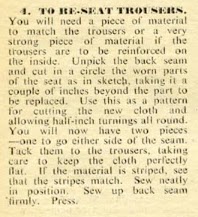
answer yes I would have to:
If my
absent-minded darling and I had lived in those days of post-war austerity, and
had his trousers needed re-seating, he would have done it himself. And there’s
no way he would have let me near his favourite jacket should the sleeve need
replacing – although perhaps necessity and peer pressure would have had an
improving effect on my practical skills.
If the trouser
seat of your absent-minded darling is getting embarrassing show him/her this:
I mock, but
gently.
This Home Notes is a
new acquisition, bought from a second-hand bookshop – in Providence, Rhode
Island, oddly enough, as it’s a British magazine (cover price 3d, bought last
month for $3).
I’ve blogged
before about my collection of housewifery books from the early to middle part
of the last century. They can be read for pleasure as social history – or they
can be useful for period details in writing fiction. As can my collection of girls' annuals.
My current
work-in-progress is a serial for The People’s Friend set in 1963. That’s within my memory – but as a
child, not an adult. It’s fascinating to glean from my housewifery books and
old magazines how different in many ways women’s lives were then – and to
imagine (not from a 21st-century
perspective) how they felt and what their private thoughts and hopes were.
And it’s
fascinating too, to see the similarities between then and now – anxieties over
weight and hair, problems with the spiteful friend or the office cadger,
pictures of celebrities (Margaret Lockwood in Home Notes).
Really, as well
as being used for writerly research, these books and magazines could themselves
inspire a thousand stories – maybe even one involving re-seated trousers.
Sunday, 3 January 2016
The Reading (and writing) Woman
I was given the gorgeous Reading Woman calendar for Christmas and I’m going to use it to mark
only writing-related events.
The picture for
January is called Portrait of Helen Gow
and is by Scottish artist Alexander Mann (1853-1908). Helen Gow is reading what appears to be a pictorial magazine – I
wonder what it was? – and she’s wearing a very lovely black lacy dress. You can see it here http://www.mystudios.com/artgallery/A/Alexander-Mann/Portrait-of-Helen-Gow.html
I’ve been
filling in events for the first few months and there is much to look forward to.
The first
Edinburgh Writers’ Club meeting of 2016 is on 11 January. Rosemary Gemmell will
talk about writing relationships and romance, and will later judge the Short
Story Competition on those themes. As many folk make New Year resolutions to write can I say, as membership secretary of the Club, that new faces are always welcome.
Also on 11
January I’m going to be interviewed on Jenny Harper’s blog.
The Writers’
Room, the fab creative writing class I’ve been going to for years, begins again
on the 15th. Looking forward to finding out what this term’s theme is.
I’m busy reading
entries for the Woman’s Short Story competition, organised by the Scottish Association of Writers. The adjudication will be delivered at the SAW weekend conference
in March and the winner will have their expenses paid at the conference. So I’m
going to make one person very happy …
I asked the
organisers if this year entrants could submit their stories with a particular
women’s magazine in mind. This was because, although the number of women’s mags
and especially those carrying fiction has dwindled almost to nothing since
their glory days of around the mid 20th century, the chances of having a
‘womag’ story published are still high compared to a ‘general’ short story –
and I assume all writers want to be published.
And on that
subject … I am delighted to be involved in The
People’s Friend (newly award-winning) workshops and will be in Dundee,
Glasgow and York this spring for the next batch:
I’ve just
finished writing the seventh instalment (out of eight) of my new People’s Friend serial. I rewrote the
final ‘chapter’ (there are five chapters in an instalment) about fourteen times
then forced myself to print it all out and put it in an envelope to avoid
further tinkering. Now I will embark on tying up the ends in the final
instalment.
And I have
another project which I shall tell you about in due course.
So, all being
well, that’s the first half of the writing year mapped out – and, of course,
along with the women on my calendar, I shall be doing lots of reading,
although, sadly, not so glamorously attired.
Subscribe to:
Posts (Atom)