katewritesandreads

katewritesandreads

Sunday, 17 January 2016

Seven in December


I read seven books in December.


Shall we Dance? by Maggie Alderson
There’s always something very glam about Maggie Alderson’s novels and this one is no exception. She is a fashion journalist after all. Here, the main character, Loulou, has a vintage clothes shop in Primrose Hill and is the sort of person who wears high-heeled wellingtons to music festivals. 


Partners in Crime by Agatha Christie
I read every Agatha Christie, most more than once, when I was young (those long winter nights on the farm … ). When our parents downsized, my sister and I divided the collection between us.

I remembered The Secret Adversary as one of my favourites, very exciting – it’s the first Tommy and Tuppence story. I was looking forward to seeing the recent TV adaptation but was sorely disappointed. Why move it to the 1950s? Why rewrite the story to such an extent? Why make Tommy such a buffoon?

As my husband had never read any Agatha Christie (I know – weird) I pressed The Secret Adversary and N or M? on him (these had fallen to me in the share-out) and he liked them so much that he asked for more.

So I bought him two more Tommy and Tuppences, Partners in Crime and By the Pricking of my Thumbs, 1970s Fontana editions.

He liked those too and I reread PiC myself when he finished it. It’s a book of short stories, some very far-fetched but, hey, this is the queen of crime. She gets away with it as far as I’m concerned. Unlike the TV producers.


The Road to Little Dribbling More Notes from a Small Island by Bill Bryson
Bill travels around Britain (well, England mostly, apart from North Berwick, Ullapool and Cape Wrath), describing his journeys in his witty, informative and often caustic way.


The Lost Woman by Gilly Stewart
Read on Kindle. Set in the Scottish Highlands. Catherine McDonald is trying to turn her family’s home into a hotel but a missing hill-walker brings unwanted attention to the area and some of her family are less than enthusiastic about her plans. Good read, with a great sense of place – as usual from this writer.


So Many Books, So Little Time: A Year of Passionate Reading by Sara Nelson
Bought in second-hand bookshop, published in 2003. I could not agree with the title more and had every hope that this American author and I would be kindred spirits. Alas no.

A whole chapter was devoted to a true crime book about murder by baseball bat. After reading it she apparently got anxious about her young son playing baseball, and about the possibilities of other sporting paraphernalia being used as weapons. I could win worrying competitions but I’ll skip that one.

I knew we weren’t on the same planet reading-wise though when she was indifferent to /dismissive of two of my very favourite books.

Housekeeping, subsequent Pulitzer prize-winner Marilynne Robinson’s first novel, was ditched after a few pages as ‘too slow’.

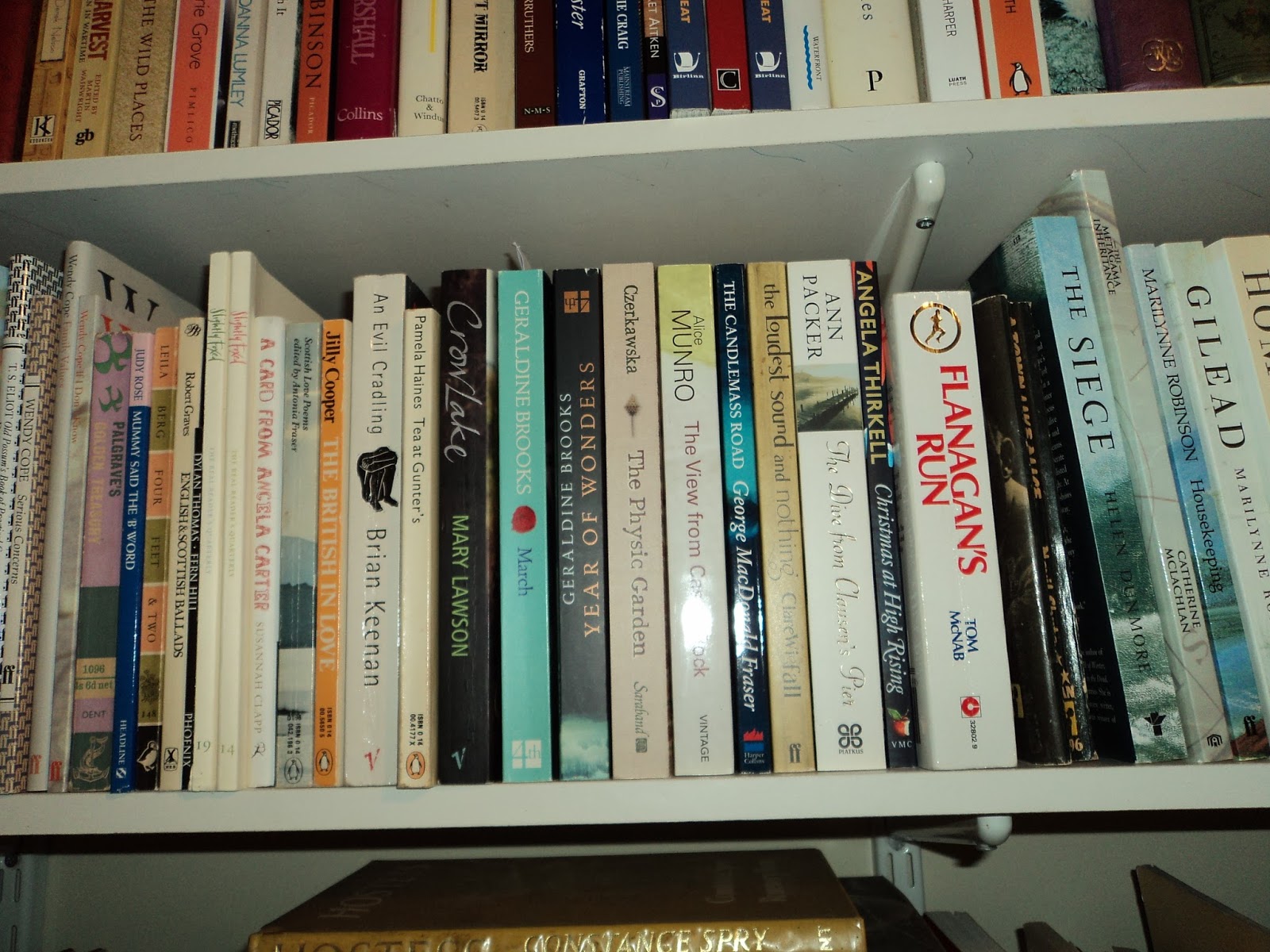
Crow Lake by Mary Lawson was newly published when Sara Nelson read it. She found it ‘pretty close to cliché’ and suspected it would be ‘ignored or even trashed’ by other reviewers. Well, perhaps it’s mean of me to, ahem, crow, but with the benefit of hindsight I know that Crow Lake got brilliant critical reviews, became a best-seller and a beloved book for many people, and that it won the Books in Canada First Novel Award and the McKitterick Prize among other accolades.

But each to their own … in the lists at the back of the book there are a few titles I hadn’t heard of that I'll look out for. Maybe we might even agree over some of them.


Plainsong by Kent Haruf
Read on Kindle. I bought this because I read that it was one of Anne Tyler’s top ten books. It’s contemporary, set in a small town in Colorado, and follows various characters and how they are linked to each other.

I appreciated it more than liked it, I think. The characters stayed in my mind but I found the almost reportage style of writing distancing.


People We Love by Jenny Harper
This is the fourth title in Jenny Harper’s very successful Heartland Series of ‘strong women under pressure’, set in a fictional town in East Lothian, Scotland. Here, Artist Lexie is back in Hailesbank, living with her parents, as they all try to come to terms with her brother’s fatal accident. ‘An engaging and delightful read,’ as Alexander McCall Smith says on the cover.

I’m very pleased to have been interviewed by Jenny Harper about writing serials, and about The Ferryboat (my People’s Friend serial now available as a large-print library book which I might possibly have mentioned before):
@harper_jenny


Sunday, 10 January 2016

Home Notes


Er, well, my answer to the question posed on the cover of this January 1951 magazine, is no. 

Sorry, dear.

Because to answer yes I would have to:


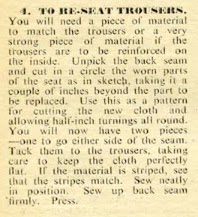
If my absent-minded darling and I had lived in those days of post-war austerity, and had his trousers needed re-seating, he would have done it himself. And there’s no way he would have let me near his favourite jacket should the sleeve need replacing – although perhaps necessity and peer pressure would have had an improving effect on my practical skills.

If the trouser seat of your absent-minded darling is getting embarrassing show him/her this:


I mock, but gently.

This Home Notes is a new acquisition, bought from a second-hand bookshop – in Providence, Rhode Island, oddly enough, as it’s a British magazine (cover price 3d, bought last month for $3).

I’ve blogged before about my collection of housewifery books from the early to middle part of the last century. They can be read for pleasure as social history – or they can be useful for period details in writing fiction. As can my collection of girls' annuals.

My current work-in-progress is a serial for The People’s Friend set in 1963. That’s within my memory – but as a child, not an adult. It’s fascinating to glean from my housewifery books and old magazines how different in many ways women’s lives were then – and to imagine (not from a 21st-century perspective) how they felt and what their private thoughts and hopes were.

And it’s fascinating too, to see the similarities between then and now – anxieties over weight and hair, problems with the spiteful friend or the office cadger, pictures of celebrities (Margaret Lockwood in Home Notes).

Really, as well as being used for writerly research, these books and magazines could themselves inspire a thousand stories – maybe even one involving re-seated trousers.


Sunday, 3 January 2016

The Reading (and writing) Woman


I was given the gorgeous Reading Woman calendar for Christmas and I’m going to use it to mark only writing-related events.


The picture for January is called Portrait of Helen Gow and is by Scottish artist Alexander Mann (1853-1908). Helen Gow is reading what appears to be a pictorial magazine – I wonder what it was? – and she’s wearing a very lovely black lacy dress. You can see it here http://www.mystudios.com/artgallery/A/Alexander-Mann/Portrait-of-Helen-Gow.html

I’ve been filling in events for the first few months and there is much to look forward to.

The first Edinburgh Writers’ Club meeting of 2016 is on 11 January. Rosemary Gemmell will talk about writing relationships and romance, and will later judge the Short Story Competition on those themes. As many folk make New Year resolutions to write can I say, as membership secretary of the Club, that new faces are always welcome.

Also on 11 January I’m going to be interviewed on Jenny Harper’s blog.

The Writers’ Room, the fab creative writing class I’ve been going to for years, begins again on the 15th. Looking forward to finding out what this term’s theme is.

I’m busy reading entries for the Woman’s Short Story competition, organised by the Scottish Association of Writers. The adjudication will be delivered at the SAW weekend conference in March and the winner will have their expenses paid at the conference. So I’m going to make one person very happy …

I asked the organisers if this year entrants could submit their stories with a particular women’s magazine in mind. This was because, although the number of women’s mags and especially those carrying fiction has dwindled almost to nothing since their glory days of around the mid 20th century, the chances of having a ‘womag’ story published are still high compared to a ‘general’ short story – and I assume all writers want to be published.

And on that subject … I am delighted to be involved in The People’s Friend (newly award-winning) workshops and will be in Dundee, Glasgow and York this spring for the next batch:

I’ve just finished writing the seventh instalment (out of eight) of my new People’s Friend serial. I rewrote the final ‘chapter’ (there are five chapters in an instalment) about fourteen times then forced myself to print it all out and put it in an envelope to avoid further tinkering. Now I will embark on tying up the ends in the final instalment.

And I have another project which I shall tell you about in due course.


So, all being well, that’s the first half of the writing year mapped out – and, of course, along with the women on my calendar, I shall be doing lots of reading, although, sadly, not so glamorously attired.

Wednesday, 16 December 2015

Nine in November


I read nine books in November.


The Hourglass Factory by Lucy Ribchester
Read on Kindle, for book group. This is a debut novel, set in London at the height of suffragette movement. The main character, Frankie, is a tomboy reporter who lives hand to mouth, always with an eye for a big story. The plot has many twists and turns, possibly too many, but the period feel is excellent – shades of Sarah Waters, and Frankie is a great character; I hope there will be more books about her. Most of the book group had been to see the film Suffragettes, so there was a good discussion about the subject; both the book and the film got a thumbs-up.


Read on Kindle. Sounds as if it’s set somewhere hot and steamy but no – although steaminess in other forms does come in to the story. The Jacaranda is the venue for a speed-dating event in London and the book then follows each of the participants as they meet up afterwards. This meant that there were a lot of characters – I found it hard to care very much about any of them.


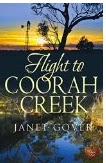
An intriguing strapline – What happens when you can fly, but you just can’t hide?

Jessica Pearson starts a new job flying an air ambulance in and out of Coorah Creek in the Australian outback – a position that suits her as she’s running away from a very difficult situation. The resident doctor Adam Gilmore has his own secrets. Throw another runaway, Ellen, and her children, into the town on the edge of nowhere; eventually all the secrets emerge. 

A flying doctor romance – what’s not to like?


This was the first book to subvert the Ladybird brand;  the Ladybird publishers were not pleased but then took up the idea themselves – a hoot.
 

I blogged here about books I liked in which patchwork is a theme. I’ve just discovered Sandra Dallas so a lot more ‘patchwork books’ are going to be added to that list. Also, most of her books are set during the American Depression, an era I find fascinating to read about.


Prayers for Sale by Sandra Dallas
Set in the mountains of Colorado. Hennie is eighty-seven and can – just – remember the Civil War, but her age doesn’t prevent her living very independently in an inhospitable terrain, helping her neighbours, and always having a bit of patchwork on the go. There’s also an old score to think about – how is she going to settle it?


The Persian Pickle Club by Sandra Dallas
I liked Prayers for Sale but I loved The Persian Pickle Club. 

‘It is Harveyville, Kansas in the 1930s, where the crops are shrivelling and there are no jobs. For Queenie Bean, the highlight of each week is the gathering of the Persian Pickle Club, a group of ladies dedicated to improving their minds. Then along comes Rita, newly wed and decidedly glamorous.’

‘Persian pickle’ is another name for Paisley pattern – isn't that great? As the group of ladies gossip, or are read aloud to, they make quilts. A story of hardship and friendship – with a murder mystery thrown in.


New Mercies by Sandra Dallas
This one does not actually feature patchwork despite the cover. Set in the Deep South decades after the Civil War – but the legacy of slavery lives on:

Nora Bondurant is running away—from her husband’s death, from his secrets, … When she receives a telegram informing her that she has an inheritance, Nora suddenly has somewhere to run to: a house named Avoca in Natchez, Mississippi. … she’s inherited a mystery. Nora’s aunt, Amalia Bondurant, was killed in a murder/suicide, and the locals are saying nothing … ’


Wonderful Marian never lets you down and this is her in grand form with a story set in Ireland and in the hilariously awful cut-throat world of American publishing. Terrific – but my favourite MK’s will always be a couple of her early ones: Lucy Sullivan is Getting Married, and Rachel’s Holiday.


Nora Webster by Colm Toibin
I loved his Brooklyn (and the recent film was brilliantly faithful to it) so was keen to read this one. Nora, widowed relatively young, with a family of four to look after, is trying to adjust to life without her husband. In small-town Ireland, in the 1960s, this is particularly difficult as everyone has an opinion on how Nora should behave. She isn’t as lovable a character as Eilis in Brooklyn but she leaps off the page in the same way.

Friday, 11 December 2015

The Palace of Complete Happiness


The Palace of Complete Happiness

Sounds blissful, doesn’t it? Although in the building thus called in the Forbidden City in Beijing it didn’t mean rooms of books and all the time in the world to read them, with pit-stops to eat toast and cheese and apples, which would be my idea of complete happiness.

For the thousands of people who lived in it, especially the Royal Family, the City was a golden cage. There would have been riches beyond the dreams of avarice there but the place would have been stiff with protocols and quarrelling eunuchs and women hobbling on bound feet and cruel punishments for small transgressions. And a cage is a cage whatever colour it is. Extremely fascinating to read about though.

Ever since I visited China in 2011 I’ve wanted to set stories there. A few months ago I was looking at a map of the Forbidden City and thought The Palace of Complete Happiness would make a great title.


This is in Woman’s Weekly Fiction Special dated January 2016.

It's contemporary – a teacher is escorting a party of teenagers around the City and finds an uncomfortable parallel between part of its history and her own life. 

Oh, and if you're looking for some Christmassy stories (and why wouldn't you be?) I have one in this anthology, called Molly's Christmas Candle.


Wednesday, 2 December 2015

The Ferryboat


My second People’s Friend serial, The Ferryboat, was published in the magazine last year.

Now The Ferryboat is available as a large-print book in libraries. It’s been published by Ulverscroft in their Linford Library Romance series.


I really like the cover. I wasn’t consulted over it but they obviously gave a good brief to their designer/artist.

This is the blurb on the back:

When Judy and Tom Jeffreys are asked by their daughter Holly and her Scottish chef husband Corin if they will join them in buying The Ferryboat hotel in the West Highlands, they take the plunge and move north.

The rundown hotel needs much expensive upgrading – and what with local opposition to some of their plans, and worrying about their younger daughter, left down south with her flighty grandma, Judy begins to wonder if they’ve made a terrible mistake.

When Shirley Blair at The People’s Friend asked me to come up with a couple of ideas for a new serial I thought a hotel would be a good setting. As a student I had two holiday jobs working in hotels so had some knowledge of behind the scenes (and some experiences completely unsuitable for sharing with People’s Friend readers … ) My mother’s father had an inn and I heard lots of stories about it. And of course I’ve stayed in various hotels.

So, thinking of all of these, I brainstormed on paper anything and everything that might be useful. The lovely West Highland setting was clear in my mind. So then all I had to do was conjure up the characters … and some plot … and write it …

My first serial, since you ask, was The Family at Farrshore and it is available in large-print too.


So off you go to the library – I do hope there is still one near you.

Friday, 27 November 2015

Interview with Mairi Wilson


I am very pleased to have fellow Edinburgh Writers’ Club member Mairi Wilson on my blog to answer questions about her debut novel Ursula’s Secret which was published in November 2015 by Black and White Publishing.


In just a few heartbreaking days, Lexy Shaw’s world has fallen apart. After her mother is killed in a tragic hit-and-run, her mother’s childhood guardian, Ursula, also dies suddenly, leaving everything to Lexy. But as Lexy reads through Ursula’s hidden papers, what she discovers raises doubts about her own identity and if she really is now all alone in the world.

Desperate to find out if she has any surviving family, Lexy travels to Africa hoping she can unravel the mystery she’s now tormented by, only to find that she’s stumbled into a past full of lies and deceit and that her life is in grave danger.


Mairi –I think Ursula’s Secret is a thrilling read and beautifully written – congratulations on its publication.

Thanks, Kate! Thanks too for inviting me to your blog – lovely to be here.

And congratulations on winning the Sunday Mail Fiction Prize which led to the publication of Ursula’s Secret! Could you tell us more about that? Was your manuscript complete when you submitted it?

And thanks again, Kate. I don’t think anyone could have been more surprised than I was to win the prize – it was an unbelievable piece of luck and I couldn’t be more grateful to those judges. And actually, a big thank you to you too, as I seem to remember that it was from one of your Club updates that I first heard about the competition.  
I’d been away on a writers’ retreat in Spain at Casa Ana which I’d first discovered through another EWC member (thanks, San) and for the first time, after three years of writing scenes out of sequence and tinkering with the same bits over and over to avoid moving on to the scenes I knew would be difficult to write, I’d finally cobbled together a rough but full draft. The deadline was just a day or two after I returned so I entered on impulse, with no expectation at all of winning, but in part to justify having had the time away and also because Black and White Publishing had undertaken to read every manuscript. I hoped eventually that might give me a way in when I had a final draft ready to submit.
When I was shortlisted and asked if I had a full manuscript the answer was of course yes – and I spent all that night going through stripping out all the ‘notes to self’ about needing more description here, rewriting this, changing that, and deleting my dozens of footnotes. Each one was deleted individually because by the time I got to those I was so tired I’d completely forgotten about the ‘delete all’ option.

How did you come up with the story? And what came first – the characters or the plot?

Characters are usually first for me and so it was with Ursula’s Secret. The story started to percolate years ago when I was living in London and my elderly neighbour, who had been Matron at the local hospital, ended up back there as a patient in the geriatric ward. Even given the little I knew of her, if she’d had any awareness of what was happening to her, I was sure that would have been the final humiliation. 
          The story started because I was thinking about what she must have been like in her prime. I was doing an OU creative writing course at the time and had to do a memoir assignment so I wrote about her (she’d become convinced I was spying on her and trying to murder her so sadly I had plenty of material). From there, I developed a short story and then that grew into the idea for the novel, which in its final incarnation bears no resemblance to any of the above, but that’s fiction for you.
            I started off with a basic idea for a romance but it’s not a genre I read often and, I’ve discovered, it’s a genre that’s much harder than it looks to write. I read family sagas and most commercial women’s fiction but have a particular soft spot for thrillers and crime so no real surprise that the story started to take a more sinister turn. I was probably about 75% of the way through when it all stalled, though. I thought at first I’d just become bored with it so should keep pushing through, but the plot felt incomplete.  And then, bingo! Another character turned up late in the day and it all started to slot into place.

There’s a great sense of place in the book – both when Lexy is in Scotland and when she’s in Malawi. I understand that you’ve never been in Africa so how did you manage to evoke it so brilliantly?

No, I haven’t been to Africa and that worried me. I’d thought I might go this autumn but then the book was about to be published and there was no time so I had to use guide and history books and the internet. There’s an amazing amount of information tucked away online - ornithologists’ blogs, newspaper archives, botanical societies. Clues and details came from all sorts of unlikely sources. I would still like to visit Malawi one of these days but am slightly concerned that I’ll find I’ve got some details wrong, although no doubt someone will point out my mistakes before that. My defence is...it’s fiction!

I don’t want to give too much away – but there’s a heart-stopping scene when Lexy gets up close to a scary creature in Malawi … I’m wondering if you acted that out in your kitchen to try and follow her movements?!

I don’t think my kitchen table would take the strain so no, I didn’t act that particular scene out. I drew instead on memories of playing ‘round the world’ at school – we had to get round the room without touching the floor and to make it more challenging we’d push desks further apart – and I also used that sensation of leaning back on two legs of a chair until it almost falls over. It was that feeling of being right at the tipping point that I was trying to capture in that scene. It was very hard to write, though, and probably the scene I least enjoyed researching. I prefer my wildlife cute and fluffy.

The book is set in Scotland and Malawi, and in two time frames, plus you spin things out so that the reader is kept on their toes with new revelations right to the end. It must have been a challenge to work out the structure – how did you go about it?

Yes, it was a challenge, and I’d no idea when I started out just how much tricky it was going to be. I wanted to make both the present and the past equally interesting and compelling so it was like writing two novels in one. I did consider only writing the story that takes place in the 1950s but quickly dismissed that as what interested me most was how something in the past could have such huge repercussions generations later. 
        I didn’t work out the structure in advance and experimented with different options as I went, getting increasingly frustrated with it all. The breakthrough came when I realised it was Lexy’s story, so the narrative thread had to stay with her. That meant following Lexy’s quest for truth so the reader discovers things as she does, feels the frustration and confusion she feels when first bombarded with names, dates and no answers, and then gradually the reader begins to make sense of it all just as Lexy does. 
      One advantage of two time frames was that when one storyline needed a ‘breather’ I could switch to the other, although that brought its own problems. How do you show the reader that the scene that’s happening ‘live’ on the page in the past is being shared with Lexy? Finding credible ways to segue from present to past was one of the hardest parts of writing this novel, but I think it would have become tedious to have had Lexy discover everything simply by reading Ursula’s papers.


How have you enjoyed all the publicity and promotion associated with winning the prize and the publication of Ursula’s Secret?

Well, mixed response to that, really. Like most writers, I’d probably prefer to keep my head down but that’s just not an option if I want to give the book the best chance it can possibly have to get into readers’ hands.  I’ve given myself a talking to about ‘getting over myself’ and it’s becoming more enjoyable now. The launch event itself, once we got underway, was great. I knew most of the people there so it was like having an extended conversation with friends, and after the first time, of course it gets easier.
When publication was just a distant dream, I’d considered hiding behind a pseudonym but winning the competition meant things moved very quickly and I’d done an interview for the Sunday Mail in my own name before I could do anything about that. With hindsight I’m glad; it’s much simpler to be myself and not pretend to be someone or something I’m not. I’m fortunate too that in a previous life I had to do a lot of presentations and so on, so I’ve become quite good at concealing my nerves. They don’t ever go away but it helps if you can tell yourself other people probably don’t realise how nervous you are.

Who are your favourite authors and have any of them influenced your own writing?

Every single book I’ve ever read must have influenced me, but of course I have favourite authors like Kate Atkinson, Maggie O’Farrell, Jessie Burton, Lesley Glaister, Ken Follett, Carlos Ruiz Zafón, and on and on through to Ian Rankin, Ann Cleeves and a whole slew of crime and thriller writers, and for years essential summer holiday reading was always the latest Robert Goddard. I’m not aware of direct influence from any one particular author but inevitably I’ll have absorbed something from all of them.

Do you have a writing routine and what are you working on now?

No, no writing routine. I work better late in the day - I’m a wonderful procrastinator so maybe that’s why – and I don’t write every day, although most days I’ll try to think about the story at least, even if only fleetingly. I’ve discovered it’s really important to keep it alive in your head. Otherwise one day away becomes two, then three and before I know it weeks might have passed and getting back into the story then becomes a daunting prospect, and that’s why Ursula’s Secret took me three years to write. 
      For the novel I’m working on now, I started with a very clear idea of three of the characters and a very vague idea for a plot so I sketched an outline and set to work with the objective of getting the story down as quickly as possible. I got through to about 70000 words and then stopped, By then I knew the story I wanted to tell so needed to recap and refine storylines and characters. I’ll probably end up cutting the first 15-20000 words as the story has evolved into something very different along the way, but I’m happy to do this as it feels right. I sometimes don’t know what I’m going to write until it’s written and that inevitably means there will be some degree of ‘wastage’ but then, who was it who said all writing is really rewriting?
     This next one is set in Spain – a county I know well and which is a lot easier to visit for research than Malawi . The story centres on two women who meet and become friends when they both go there to study the language and to leave difficult pasts behind. When one of them disappears the other sets out to find her and gets caught up in an underworld of flamenco, crime and revenge. I’m really enjoying working on it and, purely in the interests of research, I’ve started flamenco classes and feel compelled to consume tapas and Spanish wine as often as possible.

Do hurry up and finish it! Thank you for answering my questions. 


Buy Ursula's Secret here
 
Find out more about Mairi:
(with links to some YouTube interviews)

@mairi_w