katewritesandreads

katewritesandreads
Showing posts with label Margaret Forster. Show all posts

Wednesday, 5 July 2023

Six in June

I read six books in June.

No Life for a Lady by Hannah Dolby

I adored this book – it was the runner-up in the Comedy Women in Print Award in 2021, for an unpublished novel.

It’s 1895. Violet, aged 28, lives with her father in Hastings who worries that she will never find a husband. She is certain she doesn’t want to get married but what she does want is to find out what happened to her mother who disappeared ten years earlier.

Very soon she regrets employing a private detective as he seems to have his own agenda and she takes matters into her own hands. One thing leads to another, and another – the comedy comes when the reader catches on to situations of which Violet is unaware, and to her innocence (as befits a respectable Victorian unmarried woman) about the facts of life (and her curiosity on the subject).

Violet is delightful, someone it would be great fun to be friends with. The era and the setting are immersive and the resolution to the mystery unexpected.

Read this on Kindle but will be purchasing a paperback too. I hope very much that we will hear more of Miss Violet Hamilton. 


Reader, I Married Him edited by Tracy Chevalier

A book of twenty-one commissioned short stories inspired by Jane Eyre and what fabulous collection it is. The authors took the prompt and ran with it in all directions; they include Tessa Hadley, Helen Dunmore, Jane Gardam, Elif Shafak, Evie Wyld, Audrey Niffenberger and Lionel Shriver.

Two of my favourites were: one where you gradually realise that the narrator is Wallis Simpson; and a heart-breaking tale featuring Jane’s childhood friend Helen.


The Book Lovers by Emily Henry

I’m not on TikTok but am aware that Emily Henry is extremely successful as a result of being recommended on it. I see from looking at her other titles that her thing is romance with booky themes. This one, for example, has a relationship between an editor and a literary agent, both of them hustling New Yorkers, who find themselves in Sunshine Falls, North Carolina, very far from their comfort zone.

Well, what’s not to like? There was great banter and some lovely writing. I will be reading more Emily Henry.

(Bookshops/books and romance are definitely ‘a thing’ at the moment; I read a book with the same title in April.)


Three Junes by Julia Glass

An appropriate title to read in June … a Christian Aid Book Sale purchase. The ‘three Junes’ span a decade and purport to depict ‘the life and loves’ of a Scottish family, the McLeods.

I didn’t think they came across as particularly Scottish (whatever that means) and not much of the story actually takes place in the family home in Dumfries & Galloway. The characters are not given equal weight – most of it belongs to Fenno, gay, in Manhattan during the Aids epidemic.

I’d like to have, for example, seen Dennis, bad-boy turned award-winning chef and family man, up close rather than through the eyes of others.

Strangely, the last ‘June’ focused on a hitherto unmet character, not a member of the family …. I wanted to like this but it all seemed rather oblique.


 Lost and Wanted by Nell Freudenberger

I read and really enjoyed The Newlyweds by this author and so recommended her new novel (which I hadn’t read at the time) to my book group. Don’t know what they thought of it yet because I ended up not being able to attend the meeting.

And I don’t know what I think of it … it was – unexpected. One reviewer said it was 'Middlemarch meets Bridget Jones’ Diary'. Were we reading the same book?

Last month for the book group we read Lessons in Chemistry – this one could have been called Lessons in Physics. I don’t have the kind of mind to understand black holes and the decaying universe but fortunately I know someone who does and I shall be passing this on and asking for a explanation in words of one syllable.


My Life in Houses by Margaret Forster

Margaret Forster and her husband Hunter Davies had the same beginnings, brought up in council houses in Carlisle, and they met at school. Both were very clever and began, in their early twenties, to make their livings as writers.

By the time they were thirty they were earning so much (Margaret principally from her novel Georgy Girl which was made into a film) that they had to go and live in Portugal for fourteen months to avoid the Labour government’s punitive income tax.

Margaret (now sadly gone to the big house in the sky) remembers her life through the houses she has lived in, including the family home in Hampstead (bought for £5000 in 1962, with a sitting tenant) and holiday homes (at different times) in Portugal and the Lake District.

All financed from their writing and good on them… not that I’m jealous or anything …


Friday, 13 April 2018

Seven in March


I read seven books in March.


Birdcage Walk by Helen Dunmore
Read for book group. What I like about Helen Dunmore, apart from her fabulous writing, is that she never writes the same book twice. Her previous one, Exposure, was a spy novel set in 1960. This one is set in Bristol in 1792 but it also has the background of the turmoil in Europe and the French revolution. Lizzy’s family are Radicals (her pamphlet-writing mother is based on a real person) but her new husband, a property developer of what are now Bristol’s grandest houses, has everything to lose from the reality of social upheaval.

I enjoyed it but was puzzled by the first chapter which is contemporary and involves <spoiler alert>an interesting narrator we never hear of again. And there was a major aspect to the plot that I would prefer not to have known about so early on. But it was a fascinating period (‘bliss was it in that dawn to be alive but to be young was very heaven’ as Wordsworth said) and Helen Dunmore shows us a different side to it through the resourceful Lizzy.


How to Measure a Cow by Margaret Forster
Knowing I was going to be reading Margaret Forster’s schoolgirl diary for the book group at the beginning of April, I went on a little MF jag after seeing this and Isa and May in a charity shop.

Tara/Sarah has moved from London to the north of England, changing her name after a shocking event in her life. Although determined not to get involved with anyone she does find herself sort of friends with her rather lonely, older neighbour (who was brought up on a farm, hence the title). I thought it petered out towards the end and wondered if I’d got to know Tara any better than I had at the beginning.


Isa and May by Margaret Forster
Isa and May are the narrator’s two grandmothers: Isa is the posh one and May is plain speaking and working-class. The narrator, Isamay, is called after both of them. She is trying to write a thesis on grandmothers in history but as she talks to her own two she begins to find out family secrets.

Relationships are Margaret Forster’s big thing and although I like her novels I prefer her non-fiction on the same theme such as Hidden Lives: A Family Memoir.


This book made a stir when it came out last year, with some reviewers claiming that it ‘explained’ why the current president of the United States got elected. The author (in his early thirties) was brought up in Ohio, in ‘hillbilly’ country. His mother, although alcoholic and changing husbands frequently, instilled a love of learning in him. For day-to-day parenting though he relied on his maternal grandparents (Mamaw and Papaw). But while there was real love and the feeling that family, however dysfunctional, always had your back, there were also physical and verbal fights of the most ferocious nature between any combination of people, and Mamaw’s gun was never far from her hand.

Joining the Marine Corps changed Vance’s life and he ended up studying law at Yale University. But it seems you can take the boy out of hillbilly country but not all the hillbilly out of the boy. Despite his extreme change in lifestyle his loyalty to his roots is unwavering. He is clear-sighted about the problems in what is known as ‘rust-belt’ America, acknowledging, for example, the issues that some of the population have in sticking to a job when they have one, and bemoaning the disappearance of the industries that once were major employers.

Whatever your Democrat/Republican preferences are, do read this book – because it’s terrifically written and as gripping as any novel.


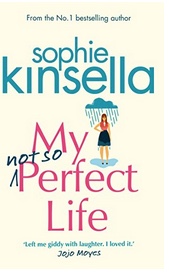
My (not so) Perfect Life by Sophie Kinsella
Katie, from deepest Somerset, is determined to make a life for herself in London. But the glamorous photographs she puts on Instagram do not reflect her ghastly commute, the tiny room she rents and her weird flatmate, and the lowly admin job she has in a PR company. When she is ‘let go’ she has to slink home to her dad’s farm and try to pretend that it’s just a temporary measure.

Sophie Kinsella is the absolute best at mixing serious with spluttering hilarity and this is no exception.


Diary of an Ordinary Schoolgirl by Margaret Forster
Margaret F died two years ago. Although they never read them while she was alive, her family knew she kept diaries as they were referred to, to check events or dates. But they didn’t know that the diary keeping had started early until they found ones she’d kept as a schoolgirl, including this one in 1954 when she was fifteen. It’s been reproduced most beautifully. There were no big revelations – she was a very enthusiastic scholar, with no interest in boys or make-up (‘soppy’). Brought up in a council house in Carlisle, she helped a lot with the housework; made some of her own clothes; went on long walks, sometimes by herself; loved listening to radio plays and going to the library. Ordinary stuff maybe, but a glimpse into someone else’s life is always of interest to me.

But you won’t ever read my teenage diary.


A Colonial Experience by David Allison
As the author says: a ‘colonial experience was the somewhat derogatory term that was given to young men who made their way from the UK to Australia in order to gain worldly and practical experience working on remote sheep and cattle stations.’ David Allison had his ‘colonial experience’ in the 1970s, going out from Scotland to work in the Australian outback – and then as an overseer on a coconut plantation in Papua New Guinea, a time full of drama to say the least.

David is my cousin and I was spellbound when I heard him talking about his Papua New Guinea adventures; he is a great storyteller. Much of that verve has been transmitted to the written word here.

It was interesting too, to read the last chapter in which he tells of a recent visit back to Papua New Guinea, finding much that was changed and much that was the same.