katewritesandreads

katewritesandreads
Showing posts with label Ann Patchett. Show all posts

Wednesday, 2 March 2022

Five in February

 I read five books in February.
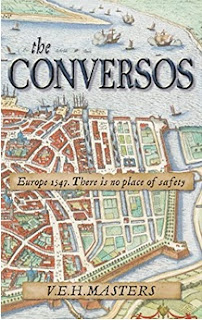
 

The Conversos by V. E. Masters


I read the first book in this series, The Castillians, when it came out last year (you can read my interview with the author here) and much enjoyed it so it was great to get reacquainted with the Seton sister and brother, Bethia and Will.

The turbulent times in which they live (middle of the 16th century) is affecting both of them. Bethia, now married to Mainard, and living in Antwerp, is discovering things about the background of her husband’s family which land her in danger.

Her forthright Fife maid, Grissel, provides some comic relief.

Will, a prisoner after taking part in the siege of St Andrews Castle described so vividly in the first book, is now a galley slave in the company of John Knox, later founder of the Presbyterian Church in Scotland. A bright spot in the dreadful life Will has to lead is the appearance <no spoilers> of another iconic figure from Scottish history.

For siblings devoted to each other, and with little contact from their homeland, it is agonising that they don’t know where the other is, or even if they are still alive.

As in The Castillians, the writing is visceral – such as the opening scenes of sea-sickness and piracy on Bethia’s voyage to Antwerp and Will’s physical agony as a galley slave. I trust that there was no first-hand research there …

And the good news is that V. E. H. Masters is at work on the third book in the trilogy.


The Dutch House by Ann Patchett

I said last month, after reading Ann Patchett’s latest collection of essays, that I wanted to read her novels. This is her newest one and I absolutely adored it. I love a sibling story (see also above … ) and this brother and sister, Danny and Maeve, leapt off the page.

Ousted by their stepmother from their architecturally extraordinary childhood home (in small-town Pennsylvania, while they are little more than children) they cannot let the house go from their minds. Together and separately they return to sit outside it again and again.

The story is narrated by Danny, the younger of the two, and so cleverly told in its weaving of past and present.

Isn’t that cover beautiful? AP was not impressed with her publisher’s cover suggestions (as she says in one of the aforementioned essays) so she commissioned a painting showing how she envisaged Maeve with her striking looks.


Commonwealth by Ann Patchett

So it was with high hopes that I immediately started reading this one, hopes that bounced down a bit as I concentrated on getting to grips with a lot of characters and time shifts that were sometimes hard to figure out.

‘Commonwealth', perhaps more a title for the American market than elsewhere, refers to the ‘Commonwealth of Virginia’. When their mother divorces their father to marry Bert, Caroline and Franny relocate there from California, and every holiday (vacation) Bert’s four children come to visit. With very little parental supervision the six do pretty much what they want, with tragic consequences.


No Man’s Nightingale by Ruth Rendell

I went through a stage a few months ago of rereading some of my Ruth Rendells before passing them on. I had no idea there was a final Inspector Wexford until I saw this in a charity shop. Reg is now retired but Mike Burden still relies on him for advice. Not her best but the bar was set high.


Was William Wallace a Jacobite? A Private Tour Through Scottish History by James A. Johnstone

James Johnstone’s livelihood came to a sudden halt in spring 2020. When Covid 19 brought tourism to a standstill there were no visitors to drive around Scotland, a job he had loved to do for the previous forty or so years.

He used his time off wisely, in writing this book. The title comes from a question he was asked, among many others, by his clients. Over the years he acquired the knowledge not only to answer but also to explain and give context.

If you want the Roberts and the Jameses sorted out in your mind or would like to learn more about the Jacobite rebellions, and much more, this is the book for you.

Look out for my interview with James Johnstone coming soon.

Friday, 4 February 2022

Seven in January

 I read seven books in January.


These Precious Days by Ann Patchett

A few weeks ago Waterstones had a three-day sale in which every single hardback was half price. I restricted myself to two, one of which is this book of articles and essays. I loved her first such volume This is the story of a happy marriage which includes a long and wonderful memoir of her life as a writer.

In this new book more than one essay concerns AP’s friendship with a woman (met through Tom Hanks – jealous, moi?) who, while she is still virtually a stranger, and a seriously ill one at that, ends up living with AP and her doctor husband during the first lockdown.

Years ago I read AP’s Bel Canto but for some reason I’ve never read her other novels; must remedy that.

She is much to be admired also for the bookshop she opened in Nashville when otherwise the city would be without one.


I like a bit of a crime spree in January. So I read these three:


Death in the Mist by Jo Allen

The seventh and perhaps the last (hope not) book in the Jude Satterthwaite series, set in the Lake District. The novel murder method might put you off camping …  Excellent.


Black Widow by Chris Brookmyre

Journalist Jack Parlabane is looking to redeem himself with a scoop, and a doctor on trial for the murder of her husband might provide one. The outcome was one I certainly didn’t see coming. Terrific.


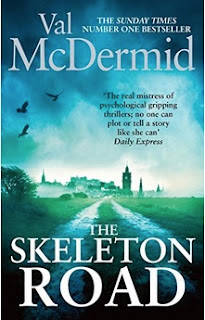
Skeleton Road by Val McDermid

The third, and the only one I hadn’t read, in the Karen Pirie cold case series. With the investigation reliving the horrors of the Balkan war in the 1990s it was a harrowing read; for me there was just too much history/backstory.


China in the Morning by Nicholas Wollaston

A charity shop purchase – my copy doesn’t have this nice jacket. Nicholas Wollaston visited China in 1960 when very few outsiders were allowed in. He found a population which seemed to be happy with their lives in Mao Zedong’s Communist Party state – one urban student couldn’t wait for her turn to be selected for the ‘privilege’ of being sent to work the land with the peasants. The ‘Great Chaos’ of the Cultural Revolution was yet to come.

His onward trip to Vietnam is also here – again he was there at a time prior to seismic events in that country.


Late in the Day by Tessa Hadley

Married couples Alex and Christine, and Lydia and Zachary, have been friends for years. Christine and Zachary were once an item and Lydia holds a candle for Alex. Each couple has a grown-up daughter, one sensible, one a mess. Their lives are as entwined as they have been since they were students but (not a spoiler) Zachary dies suddenly. Old grievances emerge when Christine invites the grief-stricken Lydia to stay with them for as long as she wants.

Tessa Hadley notices everything about her characters and their surroundings – for example, she describes in forensic detail the items in artist Christine’s studio. So it is easy to visualise it all but I didn’t care for any of the self-absorbed characters (although dead Zachary sounds as if he was jolly company).

I enjoyed The Past, the only other TH novel I’ve read, but the jury is out on this one.


Against the Loveless World by Susan Abulhawa

Read for book group. Winner of the Palestine Book Award.

Nahr has been confined to the Cube: nine square metres of glossy grey cinderblock, devoid of time, its patterns of light and dark nothing to do with day and night. Journalists visit her, but get nowhere because Nahr is not going to share her story with them.

The world outside calls Nahr a terrorist, and a whore; some might call her a revolutionary, or a hero. But the truth is, Nahr has always been many things, and had many names.

How Nahr came to be imprisoned in ‘the Cube’ is told in flashbacks. A disturbing read, obviously, but there are some bright spots too – her relationship with her mother and her grandmother, her mother’s embroidery, her love of dance and some delicious-sounding meals.

Thursday, 1 January 2015

Seven in December


I read seven books in December.

 Well, more or less.

I finished Empress Dowager Cixi by Jung Chang, started in November.

Feeling like a spot of murder and mayhem I read:

Telling Tales by Ann Cleeves. (Christian Aid sale purchase back in May.) One of her brilliant ‘Vera’ novels.

Not in the Flesh by Ruth Rendell. And this is one of RR’s brilliant Wexford novels – my favourite fictional detective.

Then I moved on to espionage:


A Colder War by Charles Cumming, spy novel, a good but not-as-good follow-up to A Foreign Country.


The Spanish Game by Charles Cumming, a satisfying follow-up to A Spy by Nature.

Being a spy sounds very exciting, but a non-existent sense of direction (among other shortcomings) would hamper me were I ever to find myself dodging pursuers. However, I conjure up the thrill of the chase by imagining when on a train, or on the Edinburgh tram, that the 'ticket inspector' coming slowly down the carriage is actually an imposter on the look-out for me. The real inspector is lying trussed up in the guard's van (or tram equivalent). I compose my face. I can only hope that its calm exterior gives no indication of the hammering heart within. I make eye-contact and smile … I’ve got away with it so far.


As is custom in our house, on Christmas Eve I read to my, now 22-year-old, daughter, The Night Before Christmas – two editions, one the traditional version:


and one with the same words but where the characters are mice:


Love them both.


Said daughter gave me a lovely little book published by Galley Beggar Press (‘a new range celebrating the best in classic short fiction’). It’s a Mr Mulliner story called Honeysuckle Cottage by PG Wodehouse. A writer of hard-boiled detective stories inherits the eponymous cottage from his aunt, a romantic novelist a la Barbara Cartland, and to his dismay finds that his writing is being influenced by his surroundings.


And I’ve been dipping into all month and just finished This is the Story of a Happy Marriage, a collection of journalism by the novelist Ann Patchett (winner of the Orange Prize for Bel Canto). Her subjects are far-ranging – from the relationship between her dog and her grandmother; to going through, and passing, all the tests to join the Los Angeles Police Department; to opening a bookshop in Nashville because there weren't any left ('The Bookstore Strikes Back'). But my favourite piece is called The Getaway Car: A Practical Memoir about Writing and Life which is just that. (I see that it’s available on Kindle as an individual entity for £1.81; highly recommended to all writers).

Her main advice, illustrated by her own experience, is to practise, practise (although being American she says practice, practice). So, if I was to break my resolution not to make any New Year resolutions, that is what I would resolve to do.

Happy 2015.